
A friend recently told me that she always comes up with the perfect comeback. Her problem is that she thinks of it 20 minutes too late. Yep, sometimes timing is everything, especially the timing of Insulin Injections in pets.
When it comes to diabetes care of our pets, timing can make the difference between a well regulated diabetic pet and a “mostly” regulated diabetic pet. Routines may not be exciting, but routines make for a well-regulated diabetic pet! After two plus decades practicing veterinary medicine, I sometimes think I have heard it all. Then a client comes along and proves me wrong. Recently one of my own veterinary clients told me he routinely gave his cat the insulin then waited an hour before feeding his pet. I don’t know where this client got this notion as I had told him what I tell all my clients, to feed and give insulin at the same time every 12 hours.
I also hear from diabetic pet owners all the time about what they do. I often hear that they want to feed a variety of foods so the pet doesn’t get bored with the food. I sometimes hear that a client gives the food and then some period of time before (or sometimes after) will give the insulin. Sometimes folks give the insulin injections at times other than 12 hours apart. I am sometimes surprised at what folks do.
So let’s chat about my preferred order of events for diabetic pets and why:
 Every diabetic pet is a unique experience. And yet, in general it is best to give equally portioned meals and equally portioned insulin injection every 12 hour as the norm. That is the ideal. Diabetic cats on tight diabetic control or pets who are tough to regulate may be a different story, but for the majority of diabetic pets, this is my preference. There is less potential for errors when there is a routine!
Humans usually ponder what they are going to eat, check their blood glucose, then give themselves a dose of insulin based on their blood glucose level and the type and quantity of food they are about to ingest. Diabetic humans are in control of their actions. And they know how they will likely react to a particular food. Clearly low carb foods will affect the glucose less than a high carb food. They know if they feel hungry before they inject themselves. We hope they make good food choices, but they can and will alter their insulin dose based on those food choices. Humans like variety in their food choices. They are in control of their actions and know if they will eat. They have an opposable digit and give themselves insulin injections. Pets can’t do this.
If we wish to minimize the variability of how much insulin to give, we must give the same diet in the same portion repeatedly to pets. Until pets can figure out how to inject themselves, please don’t change your diabetic pet’s diet on a day to day basis. Yes, pets do like treats and variety, but they would prefer to “feel good” by having good glucose regulation over a variety of foods.
Now, whether one waits to see if Fluffy is eating before giving the injection is another story. For folks who have a pet with a hearty appetite that couldn’t imagine missing a meal, they may give the injection as the pet dives into dinner. A feeding frenzy is definitely a distraction to the quick poke of an insulin needle. For folks who have a finicky eater, they might watch to make sure the pet truly eats before giving the injection. Nonetheless, I would feed the pet essentially at the same time as the injection rather than waiting any length of time. The insulin needs something to work with. If food is not given with the insulin the pet could become hypoglycemic.
How about the timing of meals?
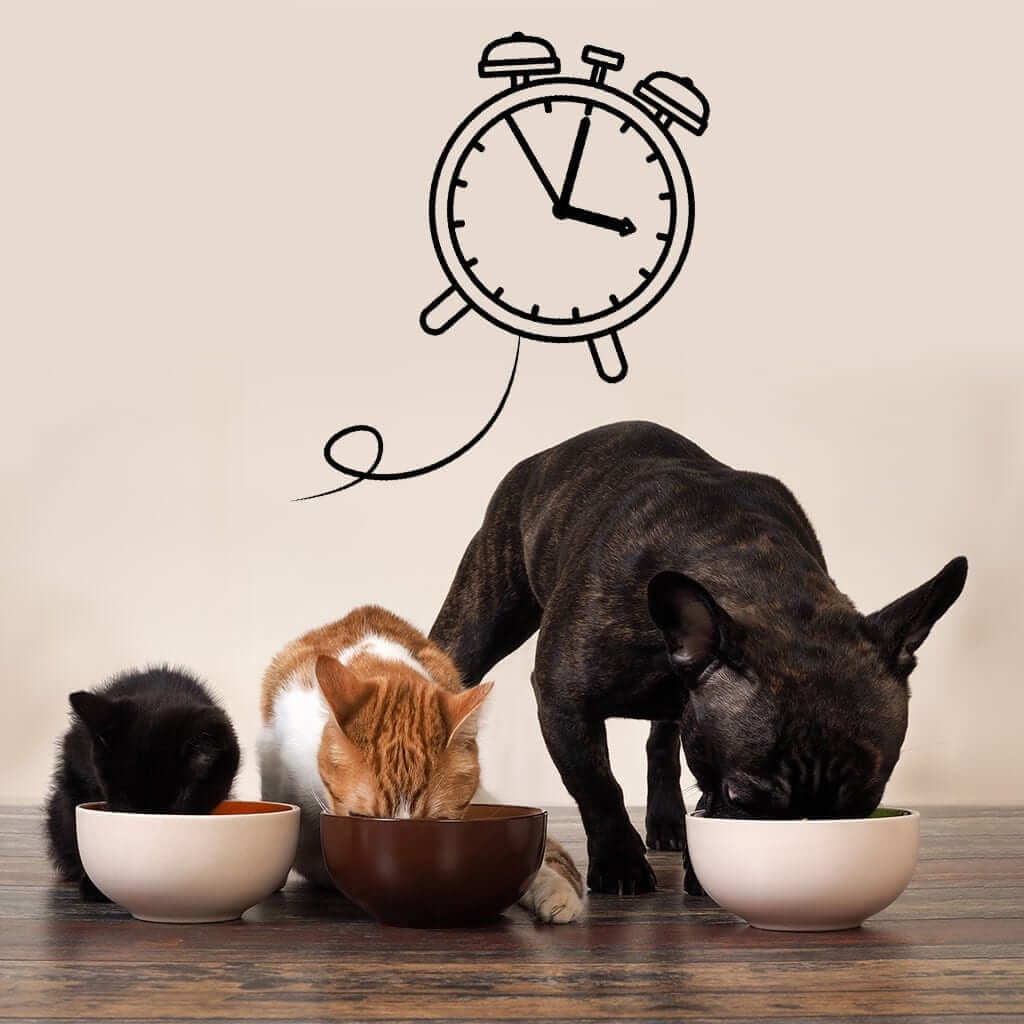 Does it matter if a pet eats in between insulin injections? Yes. Just as giving insulin without food can cause a low blood glucose reading, giving food without insulin will cause an elevated blood glucose test result. If you give a snack in the middle of the day, the blood glucose will likely rise due to the snack.
Different Eating Habits Of Diabetic Pet
- Pets can dive into their chow with such gusto you are lucky to get your hand away before setting down the food bowl.
- Some diabetic pets are more finicky about if and how much they will eat.
- A pet can have erratic blood glucose numbers and are more difficult to regulate.
- Hard to manage pets are so difficult that their humans are forced to check a blood glucose every time they fed the pet and adjust the insulin dose based on the appetite.
- The easiest to manage pets are very regular and predictable regarding blood glucose.
- No two diabetic pets are the same.
If I had my way, diabetic dogs and cats would be fed twice a day with their insulin injections. That sounds all very good on paper, but the truth of the matter is that our pets may have a different opinions. Cats especially are notorious for nibbling throughout the day. I joke that in my home pets get the same authority as humans – that it is a “democracy” in the Sutton household. In all honesty, however, the truth is that the cats wear the pants in my family. I have never had a dog boss me around so much as my cats do. If I were to feed my cats a mere two times daily, there would be no end to them telling me about it. My particularly food-motivated cat sometimes looks at the empty food bowl and then looks at me. I’m certain she is thinking, “Human, are you daft?”
My compromise for diabetic pets who think they are constantly starving is to try to get them to eat the majority of their calories at the same time as the insulin injection. For dogs who insist on a mid-day treat, I encourage a low-calorie veggie such as green beans as the snack. For cats, it is the same low-carbohydrate food as they receive as a meal, but hopefully the majority of food is given with the insulin. This stubborn food-nibbling preference of cats is likely why we tend to have greater success with longer-acting insulin for putty tats (i.e. glargine, PZI and demetir). Glargine has a relatively steady action over its duration and has been referred to as a “peak-less” insulin. Most dogs readily accept “meal” feeding twice daily, so we tend to go with intermediate-acting insulin as our first choice, such as Vetsulin and NPH.
If you have a diabetic with a healthy appetite you are lucky! It is a blessing to have a food-motivated diabetic pet compared to a finicky diabetic pet. It makes it much easier to treat the diabetes. It’s easier to predict how much insulin to give. We evaluate the insulin dosage based on periodic blood glucose curves. You probably don’t need to check a glucose before each and every injection once your pet is regulated IF you give equal portions and equal doses of insulin every 12 hours and IF your pet’s glucose is predictable. Of course, you must always use common sense.
Speaking of finicky diabetics, why might a diabetic pet not want to eat?
- Hyperglycemia can cause nausea. If a pet isn’t well regulated, the pet may not be hungry due to nausea. Yes, diabetics are often hungry, but they can be hungry and nauseous at the same time. If I have a diabetic pet patient who isn’t eating well I often send a prescription of Zofran or Cerenia to see if it helps the appetite. Regularity of appetite makes it so much easier to treat a diabetic pet.
- Additionally, pancreatitis is a common cause of diabetes in pets. The pancreas is, afterall, the organ that makes insulin. Pancreatitis causes nausea and abdominal pain. Many diabetic pets have chronic smoldering pancreatitis.
- Diabetic pets are often immunosuppressed. A high blood sugar can affect the function of white blood cells, so infections such as kidney or bladder infections could cause a poor appetite.
The above are discussion points with your vet if your diabetic pet is a finicky eater.
Timing of Insulin Injections: Before or After Meal?
Now, do you give the insulin injection before or after the meal? I typically wait to see if a pet will eat before giving the insulin injection. Again, diabetic humans usually give themselves the insulin a few minutes before they eat. The reason we wait until the diabetic pet is eating before we give insulin is actually pretty obvious: we wish to see if the pet will eat. If we give a pet an insulin injection and then the pet doesn’t eat, hypoglycemia may ensue. For good eaters who are well controlled, I will give the injection as the pet dives into the food bowl. For finicky pets, I’ll check the blood glucose and then decide how much insulin to give, taking into account how much the pet eats.
Life sometimes get is the way of our plans, but do your best to give the injections every 12 hours. Occasionally I hear of clients giving insulin injections 10 and 14 hours apart or 11 and 13 hours apart due to their family’s work and sleep schedule. Strive for 12 hours apart. Consistency is key to diabetes regulation. I encourage consistency of timing of injections and consistency of portions fed. Every family has individual quirks and schedules, but we all do our best for the love of Fluffy.
Have a question or comment? Then post below! I always enjoy hearing from my readers!
NOTE: Consult your veterinarian first to make sure my recommendations fit your pets special health needs.









Thank you so much for your article, it’s quite informative!
I currently give my dog insulin every 12 hours with equal proportions. I got the lucky one: Loves food and is not fussy with the injection! For positive reinforcement I even decided to just take out 2 pelletes (1g) from the portion she will be eating whether thats the morning food or evening food. I do this so that straight after eating and injecting she gets ‘two more’ foods as a’treat’ and a ‘well done and thank you for letting me inject you; you did a great job!’ She has learnt this and always eagerly expects it after her shot 12 hr as a scientist myself, consistency is key, but due to work: 9 days out of the 30/31 I may feed her 10-30 minutes late or 10 minutes early.
What are your opinions on this?
You’re doing a great job. 10 to 30 minutes for the days your schedule demands is acceptable. In fact, it is a far better discipline in schedule that most diabetic pets enjoy. Happy holidays!